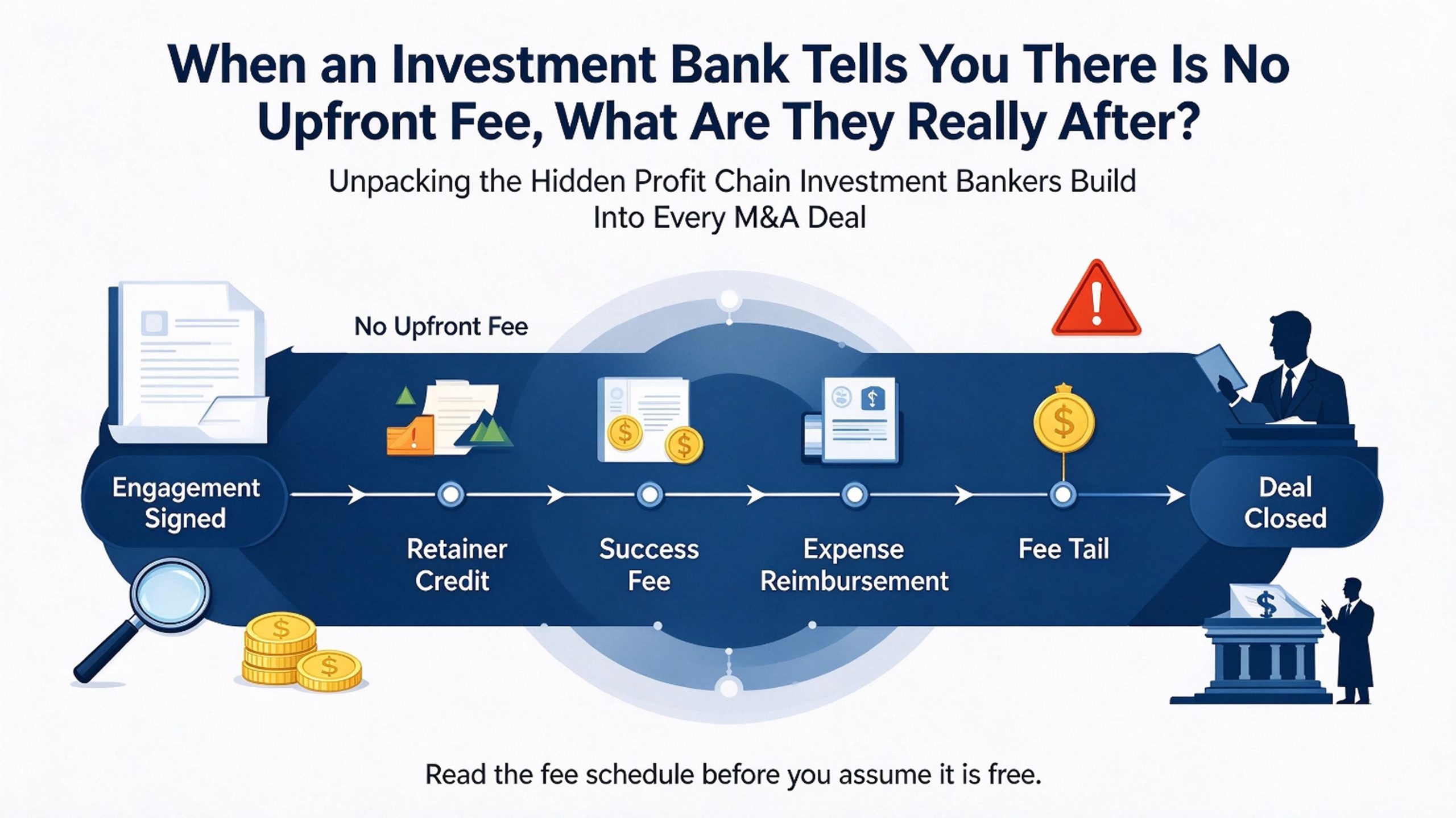
When an Investment Bank Tells You There Is No Upfront Fee, What Are They Really After? Unpacking the Hidden Profit Chain Investment Bankers Build Into Every M&A Deal
You are sitting in a conference room on the forty-second floor, and the banker across from you has just said the words that every cash-conscious founder wants to hear. There is no upfront fee. We only get paid when you get paid. It sounds like a partnership. It sounds like alignment. It sounds like the banker is so confident in their ability to close your deal that they are willing to put their own money on the line. And in some cases, that is exactly what is happening. But in the mid-market M&A advisory world, the shift toward no-upfront-fee engagements is not purely altruistic, and the founders who fail to understand what the banker is actually optimizing for are the ones who discover, months later, that the absence of a retainer did not mean the absence of cost. It meant the cost was moved somewhere less visible, buried in definitions and structures and contingent calculations that only become clear when the wire is about to hit and the final fee is calculated on a number you never expected.
The Statistics Behind the Shift and What They Reveal
Recent data from the lower middle market paints a clear picture of a changing landscape. Nearly one-third of advisors now charge no upfront engagement fee at all, a significant jump from just nineteen percent two years earlier . On the surface, this looks like a market correction in favor of sellers, a recognition that founders have grown tired of paying retainers for processes that may never close. But the same data shows that seventy-one percent of advisors still charge some form of upfront fee, which means the no-upfront model is a competitive differentiator used by a minority of firms to win mandates they might otherwise lose to larger competitors with stronger brands . The question every founder should ask is not whether the no-upfront model is generous, but why a banker would choose to absorb the risk of a failed process. The answer is rarely that they are feeling charitable. It is that the structure of the engagement letter allows them to recover that risk through other means, and those means are almost always more expensive than a transparent monthly retainer would have been.
The Success Fee Percentage Is Not the Same When There Is No Retainer
The most straightforward way a banker compensates for the absence of a retainer is by charging a higher success fee percentage. This is not a secret, and many bankers will acknowledge it openly if pressed. The logic is actuarial. If the banker takes on the risk that the deal will not close, they need to be paid more when it does close to make the expected value of the engagement worthwhile. In a retainer-plus-success structure, the banker collects some revenue regardless of outcome, which lowers the required success fee. In a pure success fee structure, the banker collects nothing unless the deal closes, which means the success fee must be large enough to cover the cost of the deals that die before closing. For a founder, this trade-off can still make sense if cash preservation is the absolute priority and the probability of closing is high. But it is a trade-off, not a gift, and the founder who understands it can negotiate the success fee percentage with the knowledge that the banker has already priced in the risk of failure. The number on the page is not arbitrary. It is a calculation, and calculations can be challenged.
The Real Profit Center Is the Definition of Transaction Value
Here is where the hidden profit chain becomes genuinely expensive. The success fee is expressed as a percentage of transaction value, and the definition of transaction value is where bankers have the most room to maneuver. In a straightforward cash deal, transaction value is the purchase price, and the calculation is simple. But most mid-market deals are not straightforward cash deals. They include earn-outs, management rollovers, retention payments, escrow holdbacks, and assumed debt, and each of these components can be included in the transaction value calculation in ways that inflate the banker’s fee beyond what the founder anticipated. The banker’s standard engagement letter will define transaction value to include indebtedness, post-closing compensation under employment contracts, and rent under leases with affiliates entered into at closing . If you are selling a business for one hundred million dollars but agreeing to stay on as a consultant for two million dollars a year for three years, the banker may calculate their fee on one hundred six million dollars, even though the consulting payments are compensation for your future labor, not proceeds from the sale of your company. The founder who does not negotiate the definition of transaction value is the founder who pays a success fee on money that is not really part of the sale.
The Earn-Out Timing Problem and the Cash Flow Trap
Earn-outs are one of the most common structures in mid-market M&A, and they are also one of the most profitable for bankers who understand how to draft the fee timing provisions. The standard engagement letter typically requires the success fee to be calculated and paid at closing, based on the assumption that the seller will receive the maximum earn-out . This means the banker gets paid their full percentage on money you have not received yet and may never receive. If the earn-out is contingent on the business hitting revenue targets over the next two years, and the business misses those targets, you do not get the money, but the banker already has their fee. The founder-friendly alternative is to negotiate a provision that ties the banker’s fee on the earn-out portion to the actual receipt of those payments. If the earn-out pays out, the banker gets their percentage at that time. If it does not, the banker does not get paid on money that never materialized. This is not an unreasonable request, and the bankers who resist it are revealing that their priority is the certainty of their fee, not the alignment of their compensation with your outcome. The same logic applies to escrow holdbacks and seller financing. The banker will want to be paid on the full amount at closing. You want them to be paid as you are paid. That negotiation is worth having.
The Expense Reimbursement That Never Goes Away
Even in a no-upfront-fee engagement, the banker will require reimbursement of out-of-pocket expenses, and this reimbursement is typically required whether or not a closing occurs . This is the quiet backdoor through which the no-upfront model becomes a de facto retainer. The banker travels to your offices for diligence, hires legal counsel to review your contracts, engages industry consultants, and produces marketing materials, and all of those costs are billed back to you. In a failed process, you may not owe a success fee, but you absolutely owe the expenses, and those expenses can run into six figures for a mid-market engagement that lasts several months. The engagement letter will describe these expenses as reasonable and necessary, but the definition of reasonable is controlled by the banker unless you negotiate a cap. You should demand a cap on reimbursable expenses, a requirement that any single expense above a defined threshold be pre-approved in writing, and a schedule of anticipated expenses by category. A banker who believes in the efficiency of their process should have no difficulty accepting a reasonable cap. A banker who insists on unlimited expense reimbursement is telling you that the no-upfront fee was never the real story.
The Tail Period and the Buyers You Already Know
The tail period is the provision that allows the banker to collect a success fee on a transaction that closes after the engagement has ended, and it is especially dangerous in a no-upfront-fee structure because it extends the banker’s claim on your future without any corresponding commitment of their time or resources. A standard tail might run for twelve to twenty-four months and apply to any buyer who was known to the company during the engagement . The banker’s argument is that they introduced you to buyers and should be compensated if those relationships eventually produce a deal. The founder’s counterargument should be that the tail must be limited to buyers the banker actually introduced with documentary evidence, and that a termination for cause should eliminate the tail entirely. In a no-upfront engagement, the tail is the banker’s insurance policy. They take no monthly risk, but they retain a claim on any deal that closes within the tail window, even if they did little work to make it happen. If you are considering a no-upfront proposal, the tail provision is the single most important clause to negotiate. A broad tail in a no-upfront engagement is the financial equivalent of a lien on your company’s future.

What the No-Upfront Model Really Optimizes For
When you strip away the marketing language, the no-upfront fee model optimizes for one thing above all else: the probability of a signed engagement letter. It is a sales tool. It lowers the perceived barrier to entry for founders who are hesitant to commit cash, and it allows the banker to win mandates that would otherwise go to competitors. Once the engagement is signed, the banker’s incentives are shaped by the other provisions in the letter, and those provisions are drafted to ensure that the banker gets paid regardless of whether the process actually serves the founder’s best interests. The success fee percentage is higher to compensate for the risk of failure. The transaction value definition is broad to capture every possible dollar. The expense reimbursement is uncapped to recover costs. The tail is long to capture future value. None of these provisions are inherently unfair in isolation. But taken together, they form a profit chain that is deliberately designed to be difficult for a founder to trace until it is too late. The banker who says there is no upfront fee is not lying. They are just telling you the least important part of the truth.
How to Protect Yourself Without Walking Away
The no-upfront model can work for the right founder in the right situation, but only if the engagement letter is negotiated with the same rigor you would apply to a retainer-based agreement. Demand a definition of transaction value that excludes post-closing compensation for your services, escrow holdbacks, and earn-outs until those amounts are actually received. Negotiate a cap on expense reimbursement and require documentation for every dollar. Limit the tail to a named list of buyers the banker introduced, delivered in writing within a specified number of days of termination. And ask the banker directly why they are offering a no-upfront structure. The answer will tell you whether they are a boutique with a genuine thesis about your deal or a firm that has simply learned that founders respond to the word free. The best bankers will explain their economics clearly, because they have nothing to hide. The ones who get defensive, who tell you that the engagement letter is standard and non-negotiable, are the ones who have built their business on founders who did not read the fine print. You are not that founder. You are the one who asked what the no-upfront fee was really for, and you are going to get a better deal because of it.