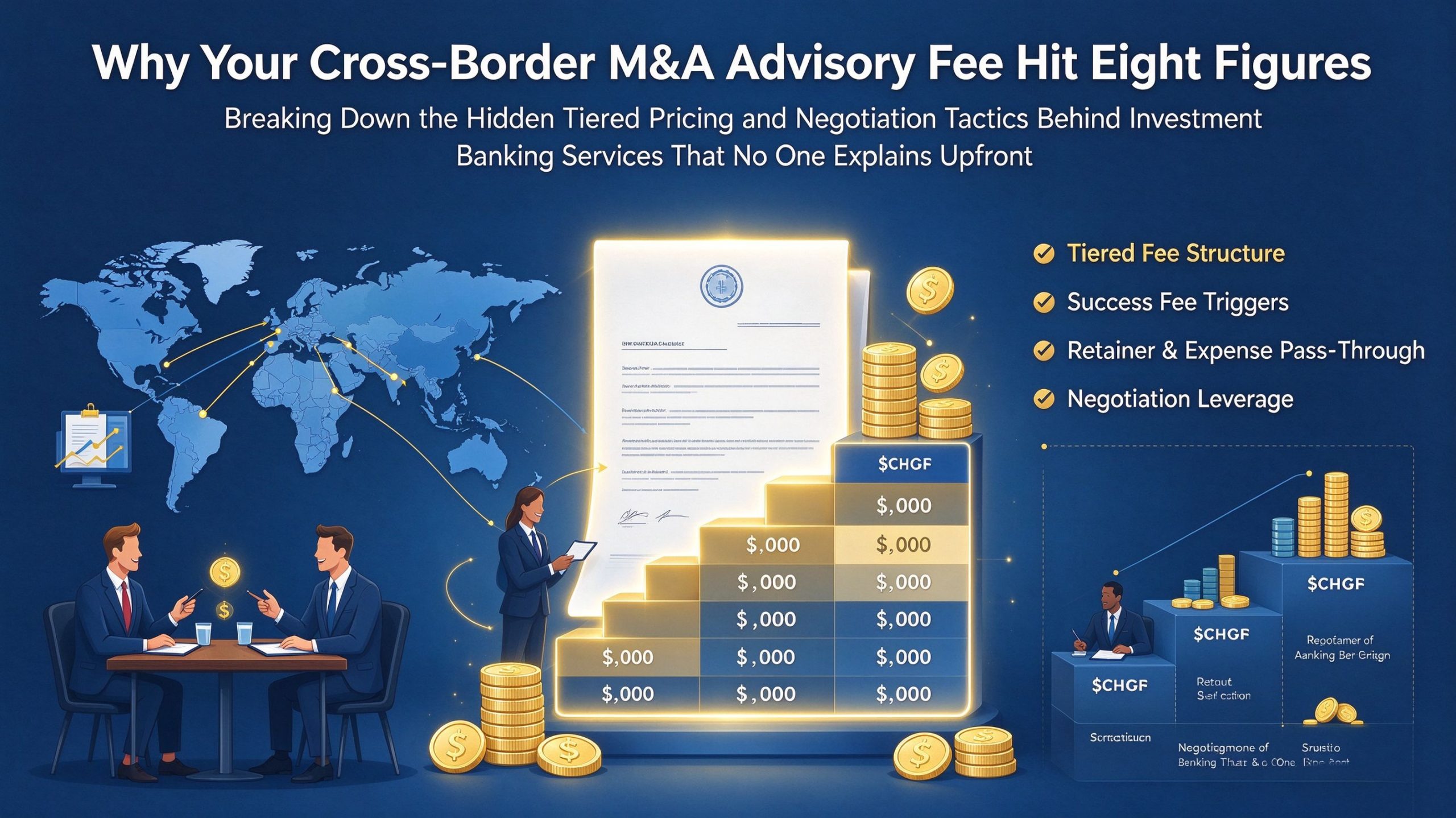
Why Your Cross-Border M&A Advisory Fee Hit Eight Figures: Breaking Down the Hidden Tiered Pricing and Negotiation Tactics Behind Investment Banking Services That No One Explains Upfront
If you have ever sold a company, or you are thinking about selling one right now, you have probably noticed something odd. The investment bankers who sit down with you in that first meeting will talk for an hour about buyer reach, process management, sector expertise, and the quality of their confidential conversations. All of that matters. But the one number you actually care about most, the number that will eventually leave your bank account, almost never comes up until the very end. And when you finally open the engagement letter and turn to the fee schedule, the figure staring back at you can feel like a typo.
An eight-figure advisory fee in a cross-border deal is not fiction. On a transaction in the billion-dollar range, a percentage that sounds perfectly reasonable on paper can turn into seven or eight million dollars in success fees without anyone doing anything illegal. Add the upfront retainer, the reimbursed expenses, and the quiet adjustments buried inside the definition of “transaction value,” and the total bill can cross ten million dollars before you have signed a single closing document. The real problem is not that investment bankers charge a lot of money. The real problem is that most sellers do not fully understand what they are agreeing to until it is far too late to change it.
This is not because bankers are dishonest people. It is because the fee structure itself is a language, and nobody bothers to teach it to you. Lehman formulas, accelerators, fee tails, known-buyer discounts, minimum success fees, and expense caps are all standard tools in the advisory world, but they are rarely explained in plain English during the pitch. This article does exactly that. It pulls back the curtain on how Investment Banking Services actually price a cross-border transaction, where the hidden costs live, and what you should be negotiating before you sign anything. The bankers who run these processes are not trying to hide the ball, at least not most of them. They are simply operating inside a template that has been copied and refined over decades, and the template was never written for you. It was written for them.
Tiered Pricing: Why Your Rate Is Never Just “One Percentage”
Most founders walk into their first advisory meeting with a simple mental model: the deal closes at some value, and the bank takes a percentage of it. That model is not wrong, but it misses the single most important fact about advisory fees, which is that the percentage is never constant. It slides. It escalates. It resets at thresholds. And the way those thresholds are drawn determines whether your final bill lands at the low end or the high end of the range. Two banks can quote you the same headline number and produce wildly different invoices depending on how those layers are built.
In the middle market, success fees typically run between one and two percent of transaction value, and they fall toward one-tenth to one-half of one percent as deals get larger. That range is public knowledge. What is not public knowledge is how the percentage moves across the layers of a deal. The classic structure is the Lehman formula, which charges five percent on the first million, four percent on the second million, three percent on the third, two percent on the fourth, and one percent on everything above four million. That formula was designed in the 1970s, when a million dollars was real money. Today, the original Lehman numbers are almost meaningless in any serious transaction, which is why the Double Lehman exists, doubling every tier so that the first million is charged at ten percent and the second at eight. A third variant simply applies a flat percentage to the whole deal but adds a large minimum, and a fourth uses a reverse structure where the rate actually rises above a certain price point.
But the eight-figure bills in cross-border M&A rarely come from a standard Lehman ladder. They come from something more subtle: the redefinition of transaction value itself. The phrase “transaction value” looks harmless in an engagement letter. In practice, its definition decides the base on which your fee is calculated. If it means enterprise value, then the debt the buyer assumes, the existing liabilities that get refinanced, and certain contingent payments can all be folded into the number. That means you can personally receive far less cash than the headline deal size, while your advisory fee is still calculated on the larger figure. You do not repay the debt, but you do pay the fee on it. This distinction becomes especially dangerous in cross-border deals, because debt structures and closing conditions vary wildly across jurisdictions, and a deal that looks clean at the equity level can be inflated into something much bigger at the definition level.
Another mechanism that quietly pushes fees upward is the escalating success fee. The traditional logic is that bigger deals deserve lower percentages, but some banks invert it. Below a certain benchmark price, they charge a fixed percentage. Above that benchmark, they charge a higher percentage on the excess. The pitch sounds wonderful: “We align our interests with yours, because the more you get, the more we get.” That is true as far as it goes, but it also means that if a buyer happens to offer a high price, the bank takes a disproportionately large share of that premium. Every extra dollar you win at the table has a bigger slice carved out for your advisor than you probably expected when you signed. The bank is not doing anything wrong. It is simply being paid in a way that rewards the top of the range more than the bottom, and if you did not notice that when you signed, you will notice it when the invoice arrives.
There is also a quieter item called the minimum success fee. When a deal is small, the minimum fee ensures the bank does not work for free. That logic is defensible, because nobody wants to staff a full team for eight months on a fifty-million-dollar deal and collect a fee that barely covers payroll. But the minimum fee becomes a problem when your deal size lands near the threshold. A nominal two percent fee on a thirty-million-dollar deal with a seven-hundred-fifty-thousand-dollar floor is actually a two-and-a-half percent fee. Every dollar of valuation you fight for at the negotiating table gets partially eaten by that floor, and the smaller your deal, the more of your upside disappears into it. Founders who have spent years watching their own valuation multiples move around tend to be sharper on this point than founders who only look at their own company, which is why so many of them keep an eye on what public investors are actually paying for similar businesses before they ever pick up the phone and call a banker.
The Retainer: More Than a Good-Faith Deposit
Banks will tell you the retainer covers the cost of preparation. Valuation work, the confidential information memorandum, the data room, the buyer list, the early outreach. None of that can wait until closing, and none of it is free. The bank needs cash flow to keep a team assigned to your deal, and that argument holds up. A good banker will say this to your face and mean it, and you should not treat the request as an insult.
But the way a retainer is designed determines whether it is a cost of doing business or a trap. The most common forms are a monthly retainer paid from signing until closing or termination, and a one-time engagement fee paid at signing. Market data from recent years shows that roughly seventy percent of advisors collect some form of upfront fee, split fairly evenly between monthly retainers and one-time fees. The same data shows a clear trend: the share of advisors relying purely on success fees has risen from about nineteen percent two years ago to nearly one-third today. Competition is pushing the industry away from upfront charges, which means banks that still insist on a retainer need a much better justification than they used to. If a bank cannot articulate that justification in plain language, that tells you something about how the rest of the engagement will go.
The single most important retainer term to watch is whether it credits against the success fee. A creditable retainer is essentially a prepayment, and at closing you only pay the difference. A non-creditable retainer is pure additional cost, stacked on top of the success fee. A fifty-thousand-dollar monthly retainer over twelve months is six hundred thousand dollars. Against an eight-figure total bill, that number looks small, but its nature is completely different. A creditable retainer is cash-flow management. A non-creditable retainer is risk-free revenue for the bank. The bank will often describe both versions using the same word, which is why you have to read the clause twice and then read it a third time.
There is another detail almost nobody asks about at signing: what happens to the retainer if the deal does not close? The answer is almost always that it does not come back. Once the bank starts working, the money becomes its revenue. That is not unreasonable, because real time and real people were deployed. But it means you should treat the retainer as a sunk cost from the moment you sign. If you are not confident the deal will close, or if you have doubts about the bank’s execution ability, a large non-refundable retainer is a risk you should not take. The same discipline applies to any large commitment you make before a process begins, whether that is a deposit on a property, a large position in a single name, or a prepayment to an advisor who has not yet shown you a single buyer.

The Fee Tail: How a Bank Follows You After the Relationship Ends
You sign a one-year exclusive mandate. The bank starts working. Six months later, the process stalls, or you decide not to sell, or you switch to another advisor. You send a termination notice and assume the relationship is over. Then, eighteen months later, you close a deal with a buyer the first bank introduced you to in the very first meeting. A bill arrives. This happens more often than most sellers expect, and it happens most often in exactly the kinds of cross-border deals where the buyer list is long and the process is slow.
That is the fee tail. Its logic is that if a transaction closes within a defined window after termination with a buyer the bank touched or introduced during the engagement, the bank still earns its success fee. There is a legitimate core to this. The bank spent time reaching those buyers, building the relationship, and running the process. If the buyer only moves after the bank is gone, the bank’s early work did create value. The problem is the length of the tail and the definition of a covered buyer. Both of those terms are negotiable, and both of them are usually left vague in the first draft because vagueness favors the bank.
Eighteen months is common in the lower middle market, but cross-border tails can run longer. Before signing, you need clarity on two things: how long the tail lasts, and which buyers count as “introduced by the bank.” The second question matters more than the first. If the agreement simply says “covered buyers,” the bank can theoretically claim every buyer that ever received a teaser, and that list can run into the hundreds. A fairer arrangement attaches a specific buyer list to the agreement, caps the number of names on it, and defines exactly which buyers trigger the tail. If a bank resists attaching that list, ask yourself why. The answer is usually that the list is the only part of the tail clause that limits their leverage.
One related clause deserves attention: the known-buyer discount. Some agreements provide that if you find a buyer yourself, or if you had already been in contact with a buyer before the engagement, and that buyer signs a letter of intent within a short window after signing, the success fee is reduced. The existence of this clause tells you something important: the banks know perfectly well that not every buyer comes from their network. If your company already has strategic buyers circling it, that discount is something you should raise before the bank raises it for you. Most sellers never ask, and the clause simply disappears from the final draft.
The Other Charges Nobody Mentions in the Pitch
Success fees and retainers are the two visible lines in an engagement letter. They are not the whole bill. The rest of the bill lives in a handful of ancillary clauses that nobody reads closely during the pitch, because the pitch is focused on the headline number and the headline number is designed to be the thing you remember.
Expense reimbursement is the first hidden layer. Travel, data room subscriptions, third-party research, background checks, translation, and notarization all add up, and in a cross-border deal they add up fast. A project spanning two jurisdictions, with multiple rounds of in-person meetings and diligence support, can generate six figures in reimbursable expenses without anyone doing anything unusual. The right response is not to refuse reimbursement. It is to cap it, or at minimum to require your written approval for any single expense above a set threshold. A bank that pushes back on a cap is telling you that it expects the reimbursables to be large, and that information is worth having before you sign rather than after.
The second hidden layer is the fairness opinion, often billed separately. If you are a public company, or if your board has independent fiduciary obligations, you may need a formal fairness opinion. In some engagement letters this is included in the base scope. In others it is a separately priced add-on. A fairness opinion can cost anywhere from a few hundred thousand dollars to over a million, depending on complexity and the bank’s brand. If you do not confirm at signing whether it is included, you will discover the answer at the worst possible moment, when closing is imminent and you have no leverage left. The same is true of any regulatory filing support, any tax structuring advice that the bank farms out to a partner firm, and any translation or localization work required by a foreign buyer’s counsel.
The third and most overlooked item is the timing of the success fee. The standard arrangement pays the full fee at closing. But if your deal includes an earnout, a seller note, or rollover equity, the bank will want those contingent components counted at face value in the fee base at closing. Your position should be the opposite. If the money has not arrived, why pay the full advisory fee on it? A reasonable compromise is to charge the cash portion at closing and charge the contingent portion when it is actually received. This clause takes time to negotiate, but it protects your cash flow in exactly the deals where cash flow matters most. A seller who accepts full-fee-at-closing on an earnout-heavy deal is effectively lending the bank money against a payment the seller may never receive.
What You Are Really Negotiating When You “Negotiate the Fee”
By now it should be clear that although the headline says negotiation, the real subject is not how to move two percent down to one-point-five. The headline rate is the least interesting number in the room, even though it is the only number most sellers remember from the meeting.
The headline rate can move. In a competitive middle market, banks do compete on price, and a motivated advisor facing two rivals will make concessions on the percentage. But the room to cut is limited, and it usually comes with a cost: less senior time, a leaner team, or a banker who becomes strangely unresponsive at the exact moment the process needs him most. The fraction of a point you save may come back to you doubled in execution quality. A deal that closes at a slightly lower price because the process was understaffed is a worse outcome than a deal that closes at a slightly higher price with a slightly higher fee.
What actually deserves your time is definitions and structure. How is transaction value calculated? Does it include debt? Does it include the undiscounted face value of earnouts? Does it include the rollover equity you are keeping in the new company? Where is the success-fee threshold set, and what is the accelerator rate above it? Is the retainer creditable, and how much of it? How long is the tail? Can the covered-buyer list be locked? Is there an expense cap? Is the fairness opinion included? Each of those questions is worth more money than the headline percentage, and each of them is negotiable in a way that the headline percentage often is not.
Each of these questions can affect the final bill more than a fraction of a point on the headline rate. A shift from enterprise value to equity value can shrink the fee base by thirty or forty percent in a leveraged deal. Raising the accelerator threshold from “anything above the benchmark” to “anything more than fifteen percent above the benchmark” can keep you out of the higher tier in most realistic outcomes. A cap on reimbursable expenses can save you a hundred thousand dollars without touching the success fee at all. Sellers who are used to thinking about optionality and exit timing in their personal portfolios, the same way they compare small positions against larger ones, tend to spot these structural levers faster than sellers who have never thought about valuation in layers. The skill is transferable. It is the same skill you use when you read any contract that has a number at the top and a definition at the bottom.
And the most important thing of all is to write everything down. When a banker says “we can work that out later” in a meeting, he usually means it. But six months later, when the process is at full boil and every hour is spent fighting the buyer, that promised flexibility will not magically appear on the invoice. The engagement letter is the only thing you can rely on. If a clause feels vague, or a definition makes you uncomfortable, do not let it slide because “this is how everyone does it” or because someone assured you it would be fine. An eight-figure fee is not created in a single moment. It is built one clause, one definition, one percentage, and one tail date at a time. Every hour you spend clarifying those details before signing can save you six figures on closing day.
Cross-border M&A is, at its core, an information-asymmetry game. Your bank is the one player in that game who is theoretically on your side but also has its own interests to protect. Most of the time those interests overlap: the deal closes, the price goes up, everyone wins. But inside the fee structure, that overlap narrows. Your job is not to treat your banker as an adversary. A good banker is worth every dollar he charges, and the best ones will walk you through the fee structure honestly if you ask. Your job is to make sure that before you sign, you understand exactly what the document in front of you says. If something still does not add up after you have read it twice, that usually means it does not add up. And in Investment Banking Services, the details that do not add up are almost always the ones that cost you the most. The sellers who come out ahead are not the ones who squeeze the last quarter point out of the headline number. They are the ones who read the definitions, asked the uncomfortable questions, and made the bank put the answers in writing before the first buyer ever saw a teaser.