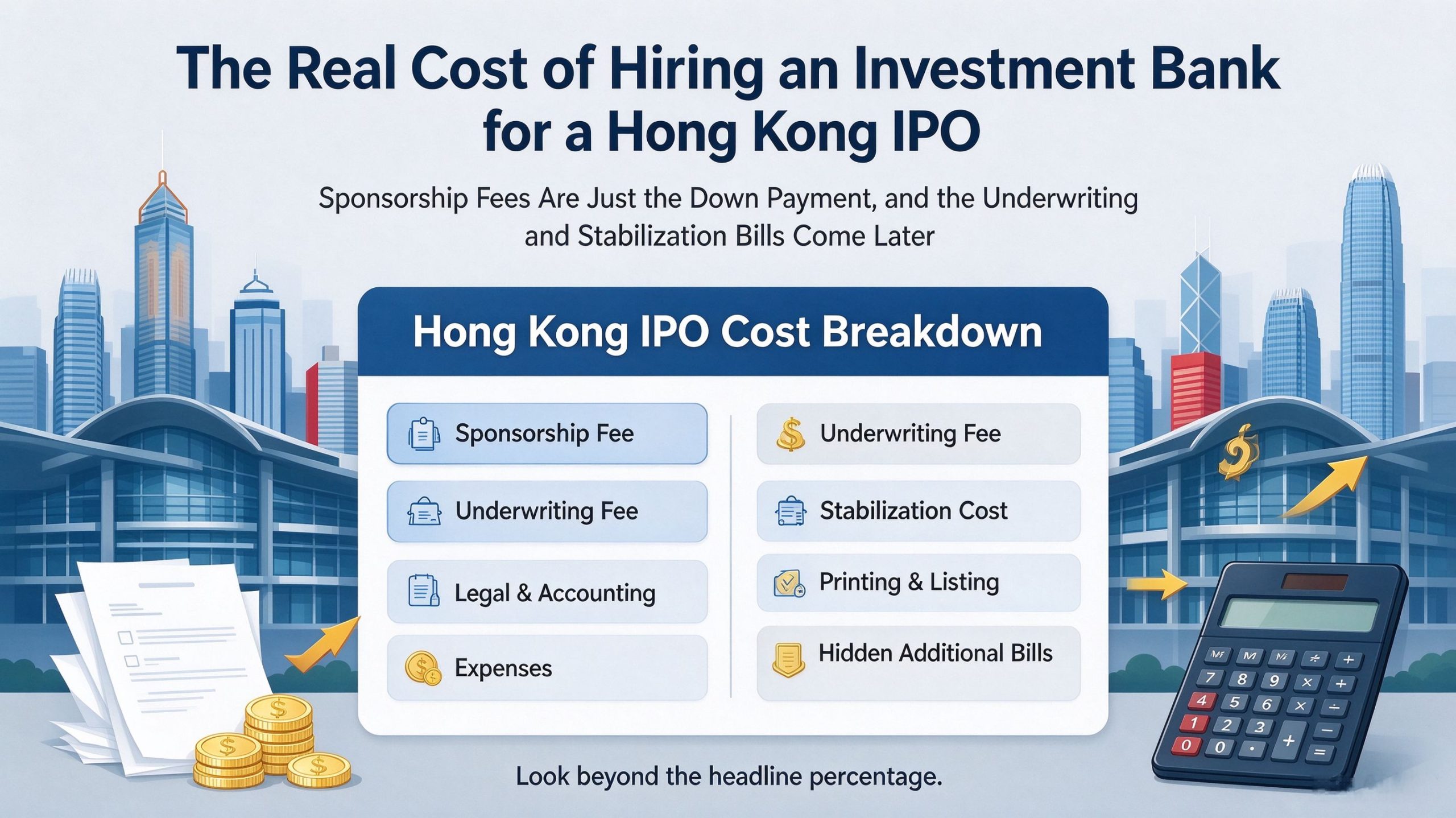
The Real Cost of Hiring an Investment Bank for a Hong Kong IPO: Sponsorship Fees Are Just the Down Payment, and the Underwriting and Stabilization Bills Come Later
Every founder who has sat across from a Hong Kong investment bank during the pitch phase remembers the same number. The sponsor fee. It is the figure that gets quoted in the term sheet, the one that gets circled in board meetings, and the one that everyone anchors on because it feels like the price of admission. It is not. The sponsorship fee is the down payment on a much larger financial commitment that unfolds in stages, and the founders who fail to map out the full cost structure before signing the engagement letter are the ones who end up shocked when the final invoice arrives months after listing day. The Hong Kong IPO process is not a single transaction with a single fee. It is a sequence of interlocking financial obligations, each with its own logic, its own timing, and its own potential for unpleasant surprises. Understanding what comes after the sponsor fee is not about being cheap or adversarial. It is about being honest with your board about what this listing will actually cost your shareholders.
The Sponsor Fee Is a Retainer, Not a Prize
When a bank quotes you a sponsor fee in the range of eight to twenty-five million Hong Kong dollars for a Main Board listing, that number buys you a specific set of services that end before your stock ever trades. The sponsor is the gatekeeper. They conduct the due diligence, they shepherd the draft prospectus through the regulators, and they put their reputation on the line by signing off on the listing application. That is a substantial and necessary service. But it is also a fixed-scope engagement that concludes when the Listing Committee grants approval. The sponsor fee does not scale with the size of your raise. It does not reward the bank for getting you a better valuation. It does not compensate them for the weeks of roadshow logistics or the delicate work of managing the book of demand. Those activities belong to a different part of the bank, a different fee schedule, and a different set of incentives entirely. The founders who treat the sponsor fee as the total cost of going public are the ones who find themselves renegotiating with their treasury team six weeks before listing because the underwriting commission alone is larger than the sponsor fee they spent months negotiating.
The Underwriting Commission Is Where the Real Money Goes
The underwriting commission is the line item that should command the most attention in any Hong Kong IPO engagement, and it is the one that founders most consistently underestimate because it is expressed as a percentage of gross proceeds rather than an absolute number. The standard range for Hong Kong IPO underwriting commissions sits between one point five percent and four percent of the total offering size, with the largest and most competitive deals pushing toward the lower end and smaller or more complex offerings landing closer to the top. For a company raising five hundred million US dollars, a two percent commission is ten million dollars. That is not a rounding error. It is a material transfer of value from your existing shareholders to the underwriting syndicate, and it is paid regardless of whether the stock trades up, trades flat, or breaks issue price on the first day. The commission compensates the syndicate for taking on the risk of distributing your shares to their institutional clients, and in a well-run book that risk is real and deserves compensation. But the percentage is negotiable, and it is negotiable in ways that the sponsor fee often is not. A founder who pushes for a lower underwriting commission in exchange for a larger and more committed cornerstone tranche, or who structures a tiered commission that rewards the syndicate for achieving a higher valuation, is a founder who understands that the underwriting fee is not a market rate set by some invisible hand. It is a negotiated term, and it should be negotiated hard.
The Incentive Fee Is the Line Item Nobody Warns You About
Buried in the underwriting agreement, usually in a clause that references “discretionary incentive fees” or “performance bonuses payable to the Global Coordinators,” is a second layer of compensation that can add another fifty to one hundred basis points to your total distribution cost. The incentive fee is the bank’s reward for a job well done, defined in the most flexible way possible. It is typically paid to the overall coordinators and the joint global coordinators, the senior bankers who own the client relationship, rather than the broader syndicate of sub-underwriters who actually place the shares with investors. The logic offered by the banks is that the incentive fee aligns the coordinators with the issuer’s interest in achieving a strong aftermarket performance. The reality is that the incentive fee is often paid regardless of aftermarket performance, and its size is frequently determined by a formula that the issuer’s finance team cannot easily verify. When you are negotiating the engagement letter, ask explicitly whether an incentive fee is contemplated, what the maximum quantum would be, and what objective criteria govern its payment. If the bank cannot give you a straight answer before you sign, assume the answer after you sign will be the one that costs you the most.
Stabilization Is Not Free, Even When It Looks Invisible
The stabilization manager, usually the same bank serving as sponsor or overall coordinator, has the right to enter the market after listing and buy shares to support the price, a practice permitted under Hong Kong’s Securities and Futures (Price Stabilizing) Rules. This activity is presented to issuers as a protective measure, a way to prevent the stock from declining below the offer price in the critical first days of trading. What is less frequently explained is that stabilization is not a charitable service provided by the bank out of goodwill. The stabilization manager is acting on behalf of the underwriting syndicate, and the syndicate has typically over-allocated shares, meaning they have sold more shares to investors than the company actually issued. When the stabilization manager buys shares in the market to support the price, those shares are used to cover the syndicate’s short position. If the stock trades well and the over-allotment option is exercised, the syndicate makes money on the additional shares. If the stock trades poorly and the stabilization manager has to buy shares in the open market, the syndicate’s profit on that portion of the distribution is reduced or eliminated. The issuer does not pay a separate stabilization fee, but the issuer pays for stabilization through the underwriting commission, which is priced to account for the syndicate’s risk and effort in managing the aftermarket. The real cost of stabilization is not a line item on an invoice. It is embedded in the commission percentage and in the strategic decisions the syndicate makes about how aggressively to support the stock, decisions that are driven by the syndicate’s own economics rather than the issuer’s long-term interest in a stable shareholder base.
The Expenses That Accumulate While You Are Not Looking
Beyond the headline fees, the Hong Kong IPO process generates a steady stream of expenses that are individually modest but collectively significant. The issuer is responsible for reimbursing the sponsor and underwriters for their out-of-pocket costs, and those costs include legal fees for the banks’ counsel, travel and accommodation for due diligence site visits and roadshow meetings, printing and production of the prospectus and ancillary documents, and a category that engagement letters often describe as “miscellaneous expenses” without further specification. A Hong Kong listing typically involves legal fees for both issuer’s counsel and sponsor’s counsel that together can range from six to twenty-seven million Hong Kong dollars depending on the complexity of the corporate structure, with red-chip or variable interest entity structures pushing toward the higher end. The auditors charge separately, with IPO audit fees for a Main Board listing commonly falling between five and fifteen million Hong Kong dollars for the three years of financial statements required, and companies with complex revenue recognition or multi-jurisdiction operations should expect the upper end of that range. Then there are the costs that no one budgets for until they appear: the compliance remediation work required to clean up related-party transactions or historical equity irregularities, the fees for industry consultants and valuation experts, the charges for financial printers who produce the prospectus under intense time pressure, and the public relations firms who manage media inquiries during the listing period. Each of these is a legitimate cost of going public. None of them are optional. And none of them are included in the sponsor fee that everyone focused on during the pitch.
What Happens If the Listing Does Not Happen
The most uncomfortable conversation to have with your bank is the one about failure. What happens if the market turns, or the regulators raise questions that cannot be resolved, or the valuation gap between what you will accept and what investors will pay proves unbridgeable? The engagement letter will address this scenario, and the language matters enormously. Standard Hong Kong underwriting agreements provide that if the global offering does not proceed, the company is not liable for the underwriting commission or the incentive fee, but remains responsible for reimbursing the banks for all costs and expenses actually and reasonably incurred. That sounds fair in principle. In practice, the definition of “reasonably incurred” is where the fight happens. The sponsor and underwriters will have spent months on due diligence, legal review, and regulatory submissions. Their costs during that period are real, and the issuer is contractually obligated to cover them even if the listing never happens. For a company that spends a year preparing for an IPO that ultimately gets pulled, the accumulated expense reimbursement can easily run into eight figures in Hong Kong dollars, with no listing and no capital raise to show for it. Before signing, ask for a detailed schedule of anticipated costs by category and by phase, and negotiate a cap on reimbursable expenses for any phase in which the offering does not proceed. A bank that believes in its ability to complete the transaction should have no objection to a reasonable cap.
The Comparison That Matters Is Not the Sponsor Fee
When you compare proposals from competing banks, the sponsor fee will be the most visible number and the easiest one to negotiate because it is a fixed amount that both sides can argue about in absolute terms. But the sponsor fee is a small fraction of the total cost of a Hong Kong IPO. The underwriting commission, the incentive fee, the expense reimbursements, and the opportunity cost of management time over the six to twelve months of preparation together dwarf the sponsor fee in almost every deal. A bank that quotes a low sponsor fee but insists on a maximum underwriting commission and an uncapped incentive fee is not offering you a better deal than a bank that quotes a higher sponsor fee but accepts a tighter commission structure. The total economics are what matter, and the total economics are only visible if you force the bank to put every fee, every expense category, and every contingent payment on a single page before you sign anything. The founders who list successfully and look back on the process without resentment are the ones who understood from the beginning that the sponsor fee was never the price. It was just the first installment.