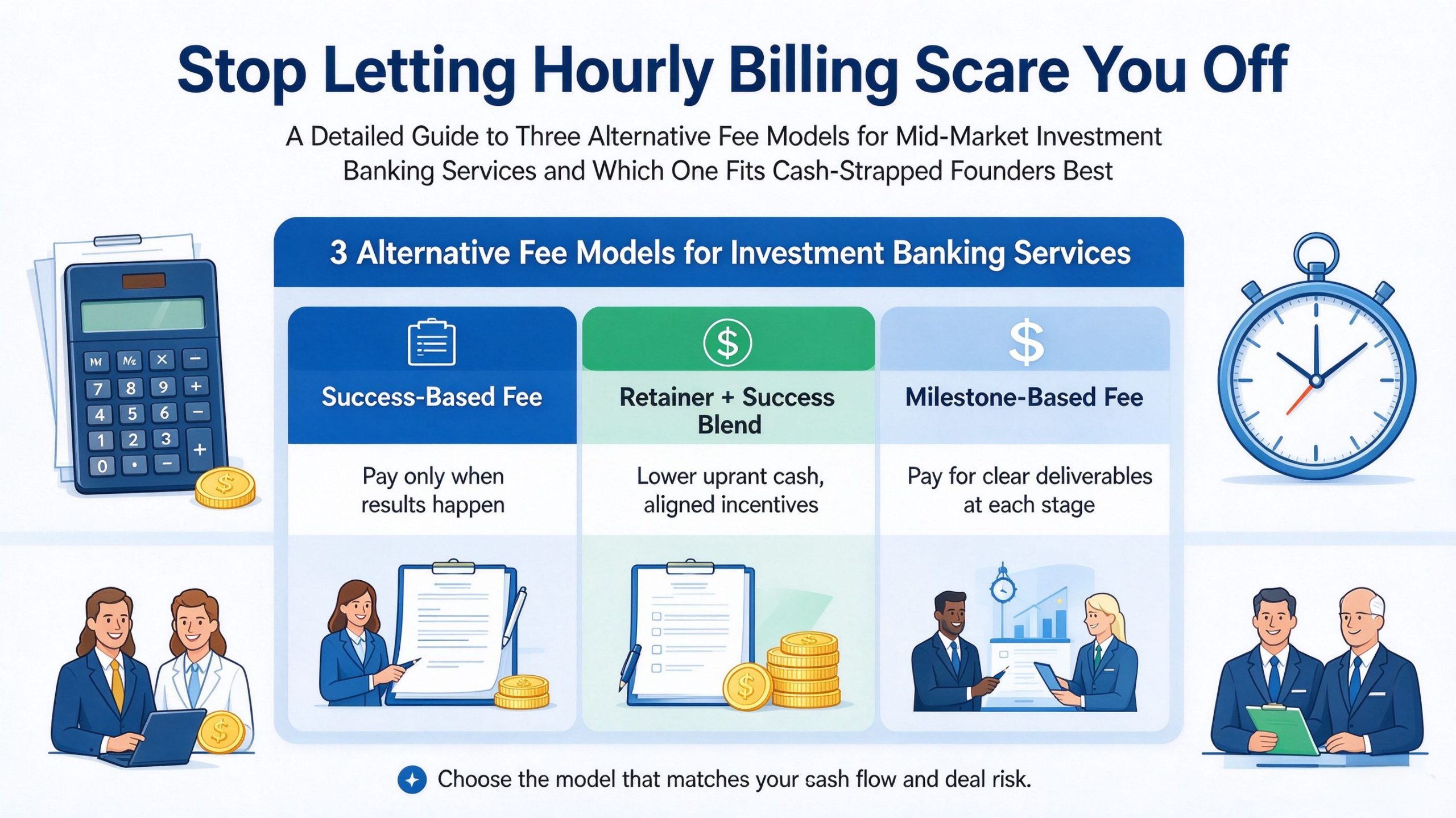
Stop Letting Hourly Billing Scare You Off: A Detailed Guide to Three Alternative Fee Models for Mid-Market Investment Banking Services and Which One Fits Cash-Strapped Founders Best
There is a moment in every conversation between a founder and an investment banker when the topic of fees enters the room, and you can feel the temperature drop. The banker says something about a monthly retainer, and the founder hears a number that feels like burning runway for a service that might not produce anything. The banker mentions a success fee, and the founder starts doing mental math about how much of the deal proceeds will actually reach their bank account. The hourly billing model, when it appears, is often the final straw. It feels like writing a blank check to someone who has every incentive to bill slowly and thoroughly. But here is the uncomfortable truth that the best mid-market bankers will tell you if you get them away from the pitch deck: the hourly model is not the villain here. The real problem is that most founders never learn how the three major alternative fee structures actually work, what each one optimizes for, and which one fits a company that is watching every dollar of burn. Understanding those structures is not about becoming a fee negotiation expert. It is about recognizing that the engagement letter is a financial instrument, and the fee model you choose determines whether your banker is rowing in the same direction as you or simply rowing.
The Retainer Plus Success Fee Model and Why It Dominates the Middle Market
The retainer plus success fee structure is the default in mid-market investment banking for a reason that has nothing to do with tradition and everything to do with incentives. The retainer, typically a monthly payment ranging from ten thousand to fifty thousand dollars for middle-market work, serves as a filter . It separates founders who are serious about a transaction from those who are simply exploring. It also funds the bank’s preliminary work, the valuation analysis, the preparation of marketing materials, and the early outreach to potential buyers, all of which happens before anyone knows whether a deal will close. The success fee, by contrast, is where the banker makes the bulk of their compensation, and it is calculated as a percentage of transaction value that scales down as the deal gets larger. The traditional Lehman formula, five percent of the first million and declining thereafter, has largely been replaced by modified versions at higher absolute levels, but the logic remains the same: the banker earns their real money only when you do . The critical term to negotiate in this model is whether the retainer is creditable against the success fee. In a founder-friendly agreement, every dollar of retainer you pay is subtracted from what you owe at closing, meaning that on a successful transaction the retainer costs you nothing extra. Many engagement letters omit this credit in the first draft, and the banker will not volunteer it unless you ask. Ask. The answer tells you something about how they view the relationship.
The Pure Success Fee Model and the Risk It Places on Your Banker
A growing number of mid-market advisors now offer a structure with no upfront fee at all, where the banker is compensated exclusively through a success fee at closing. Recent data from the lower middle market shows that nearly one-third of advisors now charge no upfront engagement fee, up from just nineteen percent two years earlier . For a cash-strapped founder, this sounds like the answer to a prayer. You preserve your runway, you get experienced advisory support, and the banker only gets paid if you get paid. But the pure success fee model is not a free lunch, and understanding why requires looking at it from the banker’s side of the table. When a bank takes on a pure success fee engagement, they are making a bet that your transaction will close. They are spending months of senior banker time, running diligence, managing buyer outreach, and navigating negotiations, all without collecting meaningful revenue until the wire hits. That risk has a price, and the price is usually a higher success fee percentage than you would pay in a retainer-plus-success structure. The banker is not being greedy. They are being compensated for the probability of failure, and in mid-market M&A the probability of failure is real. The pure success fee model fits founders who have a highly marketable business, a clear exit path, and the patience to run a disciplined process. It is a poor fit for companies with structural complexities, uncertain timing, or a founder who needs the banker’s full attention from day one.
The Fixed Fee and Project-Based Model That Nobody Talks About
There is a third fee structure that receives far less attention than the retainer or the success fee, and for a specific category of founders it may be the most appropriate choice of all. The fixed fee or project-based model charges a predetermined amount for a defined scope of work, regardless of whether a transaction closes. This is not the traditional investment banking model, and the banks that offer it are usually not the bulge bracket firms that dominate the headlines. They are boutiques, advisory firms, and former bankers who have recognized that many mid-market companies need high-quality transaction advice but do not fit the economics of a success-fee engagement. The fixed fee model works best when the scope is narrow and the deliverables are concrete: a valuation analysis, a fairness opinion, a negotiation support engagement for a deal the founder has already sourced, or a capital raise preparation package. The founder knows exactly what they will pay, the banker knows exactly what they will deliver, and there is no ambiguity about incentives because the incentive is simply to complete the agreed work. The trade-off is that the fixed fee model does not include the full sell-side process management that a success fee engagement provides. You are buying a piece of the puzzle, not the whole picture. For a founder who has already identified a buyer and needs expert help structuring and negotiating the deal, that piece may be exactly what is required.
Why Cash-Strapped Founders Should Stop Fearing the Retainer
The instinct to avoid any fee that is not contingent on closing is understandable, but it is often counterproductive for founders who are genuinely cash-constrained. A banker who is paid only on success has a powerful incentive to close a deal, any deal, as quickly as possible. That incentive aligns with your interest in getting paid, but it does not necessarily align with your interest in getting the best possible price. The difference between a quick close at eighty million and a disciplined process that yields one hundred million is twenty million dollars to you and a marginal increase in fee to the banker, and the banker knows that the disciplined process carries a higher risk of no deal at all. When you pay a retainer, you are buying something valuable: the banker’s attention during the phase when the deal does not yet exist. You are funding the preparation, the positioning, the buyer research, and the strategic thinking that determines whether you enter the market from a position of strength or desperation. The retainer is not a cost. It is an investment in the quality of the process, and the quality of the process is the single largest determinant of the outcome. The founders who understand this are the ones who negotiate a creditable retainer, set a clear scope, and then let the banker do their job without wondering every month whether they are being taken for a ride.
The Tail Period and the Clause That Determines What You Actually Owe
No discussion of mid-market investment banking fees is complete without addressing the tail, the provision that allows the banker to collect a success fee on a transaction that closes after the engagement has ended. The logic is reasonable: if the banker introduced you to the buyer who eventually acquires your company, they deserve compensation even if the closing happens six months after the engagement letter expires. The problem is that tail periods are routinely drafted far more broadly than that logic requires. A typical tail might run for twelve to twenty-four months and apply to any buyer who was known to the company during the engagement, not just buyers the banker actually introduced with documented evidence . The brutal question every founder must ask is whether the tail is limited to a written list of parties the banker actually contacted, delivered within a specified number of days of termination. If the banker cannot produce that list, the tail should not apply. The second question is what happens if you terminate the engagement because the banker breached their obligations or failed to deliver a credible process. In a fair agreement, a termination for cause kills the tail entirely. Any banker who insists that the tail survives their own misconduct is telling you that the clause is designed to protect the bank, not to serve you.
How to Choose the Fee Model That Fits Your Actual Situation
The right fee model is not a matter of ideology. It is a matter of fit between the structure and the realities of your company, your transaction, and your balance sheet. If you have a highly marketable business with clean financials, a clear strategic story, and the ability to wait for the right buyer, the pure success fee model can work beautifully because your banker’s incentive is maximally aligned with yours and you preserve cash during the process. If your business has complexity, if the transaction requires extensive preparation, or if you need the banker’s full attention from the first day of the engagement, the retainer plus success fee model is the more honest structure because it funds the work that must happen before a deal exists. And if you have already found your buyer and simply need expert help getting the transaction across the finish line, the fixed fee or project-based model may be the most efficient use of your limited capital. The worst outcome is not paying a retainer. The worst outcome is choosing a fee model that creates a misalignment between what you need and what your banker is incentivized to deliver, and then discovering that misalignment only after the deal is done and the invoice arrives.

What the Best Bankers Will Tell You If You Ask Directly
Ask a mid-market banker who has been doing this for twenty years what fee structure they prefer, and the honest ones will tell you something that the pitch books do not say. They prefer the structure that allows them to do their best work without worrying about whether they will be paid. That usually means a retainer that covers their costs and a success fee that rewards a good outcome, with a tail that is limited and fair and a credit against the success fee that acknowledges the client’s cash contribution. The bankers who resist these terms are not necessarily dishonest, but they are optimizing for their own certainty rather than for the quality of the engagement. The founders who get the best outcomes are the ones who understand that the fee negotiation is not an adversarial exercise. It is the first test of whether the banker is a partner or a vendor. A partner will explain their fee structure clearly, justify why each component exists, and negotiate the terms that matter to you because they want the relationship to start on a foundation of trust. A vendor will hand you a standard engagement letter and tell you that everyone signs it. You already know which one you want in your corner when the process gets difficult.