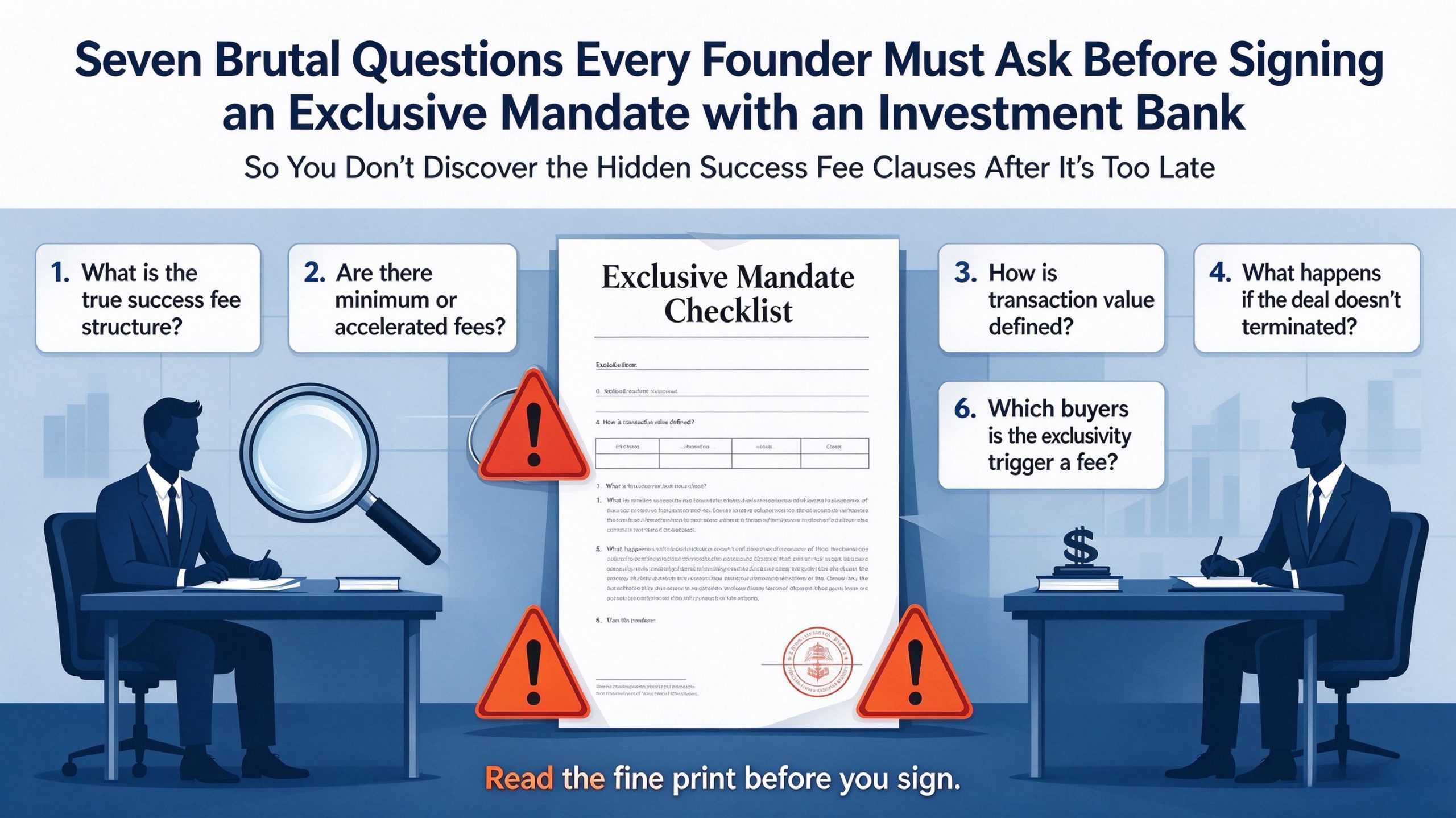
Seven Brutal Questions Every Founder Must Ask Before Signing an Exclusive Mandate with an Investment Bank, So You Don’t Discover the Hidden Success Fee Clauses After It’s Too Late
You have spent years building something real. The product works, the team is solid, and the first serious acquirer just sent a signal that they want to talk. Your board is pushing you to hire a bank. The banker sends over a two-page engagement letter that looks like standard boilerplate, and everyone tells you not to overthink it because time is of the essence. This is exactly the moment where fortunes are quietly transferred. An exclusive mandate with an investment bank is not a vendor agreement for office supplies. It is a financial instrument that transfers a significant chunk of your life’s work to a third party under conditions that are often deliberately opaque. The brutal truth is that most founders discover the true cost of their banker relationship only after the wire hits, when the “success fee” turns out to be far larger than the headline percentage suggested, or when a buyer you sourced yourself triggers a fee you never anticipated. Before you sign on the dotted line, you need to ask questions that your banker hopes you will never think to voice. These questions are not about being difficult. They are about being a fiduciary to your own shareholders.
Who Actually Owns the Relationship With the Buyer I Already Found?
The single most expensive mistake founders make in an exclusive mandate is failing to carve out the buyers they have already cultivated before the banker enters the picture. You likely have a warm lead, an inbound inquiry, or a strategic partner you have been courting for months. The banker will smile and assure you that of course, those relationships are yours. But the language in the engagement letter often tells a different story. Many mandate agreements contain broad definitions of “Transaction” and “Introduced Party” that sweep in every buyer who engages during the exclusivity period, regardless of who picked up the phone first. If you do not explicitly list your pre-existing contacts in a carve-out schedule attached to the agreement, you may find yourself paying a full success fee on a deal you effectively closed yourself. The brutal question is not whether the banker deserves compensation for work they perform, but whether they deserve compensation for work you performed before they arrived. Ask for a named list of excluded parties, and refuse to sign until that list is attached as a formal exhibit. If the banker resists, that resistance is your first data point about how they view the boundaries of their value creation.
What Exactly Counts as the Transaction Value That Triggers the Fee?
The success fee is almost always expressed as a percentage of “Transaction Value,” and the definition of that term is where the real negotiation lives. Bankers will push for the broadest possible definition, one that includes not just the equity purchase price but also earn-outs, management rollovers, retention bonuses, and any debt assumed by the buyer. On the surface, this seems reasonable because the banker wants to be paid on the full economic value of the deal. But consider what happens when a significant portion of your consideration is contingent. If the buyer agrees to pay you based on future performance milestones, the banker may still demand their full percentage on the total headline number at closing, even though you may never see those earn-out dollars. The brutal question is this: will the banker’s fee be reduced if the contingent consideration never materializes? You need a success fee structure that aligns the banker’s payout with the cash you actually receive. The most founder-friendly agreements tie the banker’s fee to proceeds received at closing, with a separate, reduced fee schedule for any earn-out payments as they are actually paid. Any banker who insists on being paid on money you might never see is telling you that their incentive is to get a deal signed, not to get you the best possible outcome.
What Happens If I Fire You Because You Are Doing a Terrible Job?
Exclusivity means you cannot hire another banker. It also means that if your banker assigns a junior associate to your account, stops returning your calls, or runs a process that generates no serious buyers, you are stuck. The engagement letter will almost certainly contain a termination provision, but the terms of that provision matter enormously. Many mandate agreements allow the bank to terminate for “cause” only in the narrowest circumstances, while giving the bank the right to collect a tail fee for months or even years after the engagement ends. The brutal question is whether you have the right to terminate for convenience, without cause, and what the fee consequences of that termination will be. A fair agreement gives you the ability to fire the bank if they fail to deliver a credible process within a defined window, and it limits any post-termination fee to transactions with buyers the bank actually introduced during the term. If the bank insists on a long tail period that survives your termination for any reason, you are essentially handing them a lien on your company’s future. Walk away from that.
Is the Banker Incentivized to Get Me a High Price or Just a Fast Price?
This is the question that cuts to the heart of the agency problem in investment banking. The banker’s retainer is usually modest, and the success fee is where they make their money. But a success fee based on a percentage of transaction value creates a strange incentive: the banker gets paid the same percentage whether you sell for eighty million or one hundred million, as long as the deal closes. The difference in their absolute fee between those two outcomes might be a few hundred thousand dollars, while the difference to you and your shareholders is twenty million. For the banker, the marginal effort required to squeeze out that extra twenty million is often not worth the risk of losing the deal entirely. The brutal question is whether the fee structure includes an escalating success fee above a certain valuation threshold, sometimes called a “ratchet” or a “performance kicker.” You want a structure where the banker’s percentage increases if they exceed a target price you both agree is ambitious but achievable. This aligns their incentive with your outcome rather than with the mere completion of a transaction. If the banker refuses to discuss a ratchet, you are talking to someone who is optimizing for their own certainty, not your upside.
What Hidden Fees and Expenses Will I Be Responsible For?
The success fee is the headline number, but the engagement letter contains a dozen other provisions that can quietly drain your bank account. The banker will require reimbursement for “reasonable expenses,” which in practice can include first-class travel, luxury accommodations, and technology fees that seem plucked from thin air. There is also the indemnification clause, which requires you to cover the banker’s legal costs if they are sued in connection with the transaction. These clauses are often presented as non-negotiable, but they are almost always negotiable. The brutal question is whether you are willing to write a blank check for expenses you do not control. You should demand a cap on reimbursable expenses, a requirement that any expense above a certain threshold be pre-approved in writing, and a carve-out to the indemnity for the banker’s own gross negligence or willful misconduct. A banker who refuses to accept a reasonable expense cap is a banker who views your transaction as a cost-plus contract with your wallet as the funding source.

What Is the Tail Period and Why Does It Feel Like a Trap?
The tail period is the provision that allows the banker to collect a success fee on a transaction that closes after the engagement has ended. The logic is straightforward: the banker spent months preparing your company, introducing you to buyers, and managing the process. If a deal closes six weeks after the engagement expires with a buyer the banker brought to the table, the banker should be compensated. The problem is that tail periods are routinely drafted far more broadly than that logic requires. A typical tail period might run for twelve or eighteen months after termination, and it might apply to any buyer who was “known to” or “had contact with” the company during the engagement, not just buyers the banker actually introduced. The brutal question is whether the tail period is limited to buyers the banker can prove they introduced, with documentary evidence, and whether the tail period is reasonable in duration. You should also ask what happens if you terminate the engagement for cause because the banker breached their obligations. In a fair agreement, a termination for cause kills the tail entirely. If the banker insists that the tail survives even a termination for their own misconduct, you are looking at a clause designed to protect the bank, not to serve you.
What Happens to My Company If the Deal Falls Apart?
The final brutal question is about the aftermath. Most deals do not close. The process is grueling, it distracts your management team, and it leaks information to customers and competitors. If the deal dies, you are left with a depleted bank account from retainer and expense payments, a demoralized team, and a banker who has already moved on to the next engagement. The brutal question is whether the engagement letter contains any provision for what happens to your confidential information after the process ends, whether the banker is restricted from working with your competitors on a similar transaction for a period of time, and whether you have any recourse if the banker’s negligence or conflicts of interest caused the deal to fail. You should also ask for a clear definition of what constitutes a “failed process” and whether any portion of the retainer is refundable in that scenario. Most bankers will tell you that retainers are non-refundable, which is standard. But the broader question of whether the banker has any skin in the game beyond the monthly check is worth pressing. The best bankers will structure a deal where a meaningful portion of their compensation is at risk, because that is the only way to know that their interests are truly aligned with yours.
The engagement letter is not a formality. It is the document that determines whether your banker is a partner in your success or a toll collector on your exit. Read every clause. Ask every question. And if the banker’s answers are evasive, or if they pressure you to sign without legal review, remember that exclusivity is a one-way door. Once you sign, you cannot undo the terms. The founders who maximize their outcomes are the ones who treat the mandate negotiation with the same rigor they applied to building the business in the first place.